If you’ve ever walked a construction site—whether it’s a new housing development, a highway expansion, or a commercial warehouse build—you might have noticed the quiet, heavy-duty workhorses moving materials that would make human labor impossible to do safely, quickly, or cost-effectively. For years, construction operations have relied on a mix of wheeled dump trucks, front loaders, and temporary conveyors to transport soil, gravel, concrete aggregate, and construction waste. But as construction teams push for higher efficiency, lower emissions, and reduced on-site safety risks, one question keeps popping up: Can solid woven conveyor belts (SWCBs)—the heavy-duty, multi-ply belts most often associated with mining, agriculture, and manufacturing—actually work in the construction industry? Solid Woven Conveyor Belt

As a solid woven conveyor belt supplier with over a decade of experience working with both industrial and construction clients, I can tell you the answer isn’t a simple yes or no. It’s a “yes, but only if you understand how SWCBs are designed to meet construction’s unique demands, and how to integrate them properly.” Too many construction teams write off conveyor belts as mining equipment, too slow or too fragile for the rough, variable environment of a job site. But over the last five years, I’ve seen more and more general contractors, civil engineers, and waste management companies adopt SWCBs, and the results have been game-changing for small and large projects alike. Let’s break down why this shift is happening, where SWCBs fit in construction, and what to watch out for when using them on your next project.
First, let’s get clear on what solid woven conveyor belts are, and how they differ from the lighter fabric or rubber belts you might see on grocery store checkouts or small warehouse sorters. Unlike those thin, single-layer belts, SWCBs are made by weaving multiple layers of high-tensile synthetic fabric (usually polyester, nylon, or a blend) into a single, continuous ply, then bonding it with a wear-resistant rubber cover. The weaving pattern creates a uniform, high-strength core that can handle far more tension and abrasion than standard conveyor belts—critical for moving heavy, sharp, or abrasive materials. That strength is why SWCBs are the go-to for mining operations hauling raw ore, but their design also makes them surprisingly adaptable to construction’s needs, which are very different from a mine’s.
Construction sites present three unique challenges that most standard conveyor belts can’t handle: constant uneven terrain, frequent material changes, and strict requirements for dust control and emissions. Let’s start with terrain. Construction sites are rarely flat. You’re moving from a dig pit that’s 20 feet below grade to a stockpile that’s 15 feet above, and the ground under the conveyor itself is often muddy, rocky, or sloped. Standard conveyor belts, which are thinner and less durable, tear easily when they drag over uneven ground or get snagged on rebar, wood scraps, or loose concrete chunks. SWCBs, with their thick, reinforced rubber covers and woven core, resist that kind of damage far better. I’ve supplied SWCBs to a highway construction project in Texas where a temporary conveyor ran over a section of broken limestone and rebar for 12 weeks straight; the standard belt they’d used before only lasted 10 days, and the SWCB lasted the full project timeline without a single tear or unplanned downtime.
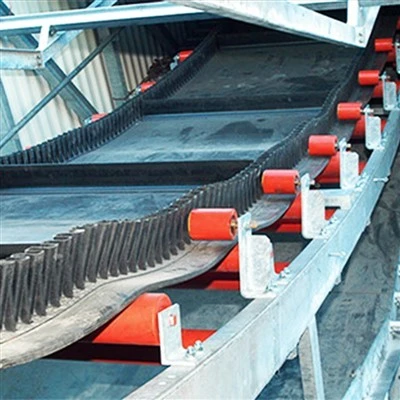
Next, construction sites often handle a mix of materials in a single day: this morning you’re moving topsoil for landscaping, this afternoon you’re hauling broken concrete for recycling, and tomorrow you’re transporting sand for concrete mixes. Each of these materials has different properties: topsoil is fine and can stick to belt surfaces, broken concrete has sharp edges that abrade rubber, and sand is high-volume and can stress the belt’s edges. SWCBs are built to handle that variability. The woven core distributes tension evenly across the entire belt, so even if a portion of the belt is carrying sand at 200 tons per hour and another is carrying light topsoil, there’s no weak point that’s likely to snap. The rubber covers are also customizable: we can add a smooth cover for fine materials that need easy release, a chevron pattern for steep slopes to prevent slippage, or a tear-resistant cover for sharp construction debris. That flexibility is a big reason contractors are switching from temporary belt conveyors that need frequent replacement to SWCBs that can adapt to whatever the job site throws at them.
Then there’s emissions and worker safety, two pressures that have pushed construction to move away from diesel-powered heavy equipment over the last decade. A single dump truck moving material from a dig pit to a stockpile emits about 2.7 pounds of carbon dioxide per mile, and on a 10-acre construction site, that can add up to hundreds of tons of emissions over a project timeline. It’s also risky: dump trucks backing up across site paths are one of the leading causes of on-site accidents, especially for laborers working near the edges of dig pits. SWCB-based conveyor systems are electric-powered (we supply modular conveyor frames that run on standard construction site power, so no need for extra generators) and eliminate the need for short-haul trucking, cutting emissions by up to 90% for on-site material transport. They also reduce safety risks: conveyors can be fenced off to keep laborers clear of moving parts, and because they run along fixed paths, there’s no risk of a truck backing into a worker or tipping on uneven ground. I worked with a residential construction company in Florida last year that replaced three dump trucks with a 200-foot SWCB system; they reported a 75% drop in minor on-site incidents and a 40% reduction in their project’s carbon footprint. That’s not just good for the environment—it’s also helped them qualify for local green building incentives, which offset the cost of the conveyor system.
Of course, SWCBs aren’t a one-size-fits-all solution, and there are situations where they don’t make sense for construction projects. For small, short-term projects—like a 1,000-square-foot home build that only needs to move soil for a week—the upfront cost of a SWCB system might not be worth it. A standard light-duty conveyor belt is cheaper to rent for a few days, and you don’t need the heavy strength of a solid woven belt for small volumes. But for medium to large projects—anything over 5,000 square feet, or projects that will last more than a month—SWCBs offer a much better return on investment. I’ve calculated that for a 6-month commercial construction project, the cost of a SWCB system (including the belt itself and modular conveyor frames) is recouped in saved labor, lower equipment rental, and reduced downtime by month four. The average downtime for a standard belt is 1-2 days per month for repairs and replacement; SWCBs only need minor maintenance (like cleaning and tension checks) once every two weeks, which adds up to a lot of saved time.
Another factor to consider is handling construction waste, which is a huge part of the construction industry’s environmental impact. The EPA estimates that construction and demolition waste makes up 25% of all solid waste in the United States, and only half of that is recycled. SWCBs are ideal for moving construction waste like broken concrete, asphalt, and wood scraps to on-site recycling facilities. Their tear-resistant design can handle sharp, uneven waste materials that would puncture a standard belt, and the modular conveyor frames can be adjusted to run directly to a crusher or recycling bin, so you don’t have to move waste multiple times with trucks. We even supply special cut-resistant SWCBs for clients that handle rebar scraps, which is a common headache for construction waste managers—those belts have a reinforced outer layer that can resist being cut by exposed rebar, so you don’t have to shut down operations every time a piece of rebar gets stuck on the belt.
Now, if you’re a construction manager or site supervisor reading this, you’re probably wondering: how do I actually integrate a SWCB system into my site? The first step is to work with a supplier that specializes in both conveyor belts and construction site needs, not just generic industrial supplies. A good supplier will help you size the belt correctly—too thin, and you’ll have frequent tears; too thick, and you’ll be paying for strength you don’t need. We work with contractors to assess your project’s material type, volume, and site layout, then recommend the right belt thickness, cover type, and conveyor frame height. For example, if you’re moving steep piles of gravel, we’ll recommend a chevron-patterned SWCB cover to prevent slippage, and if you’re working in a muddy site, we’ll suggest a belt with a low-friction bottom cover to make it easier to pull over uneven ground.
Another key tip: don’t skimp on installation and maintenance. SWCBs are durable, but they’re not indestructible. A common mistake contractors make is using temporary, low-quality rollers or frames that don’t support the belt evenly, which causes premature wear. We work with clients to install custom conveyor frames that are spaced to match the belt’s tension capacity, and we provide a free maintenance guide that includes monthly checks for belt alignment, tension, and cover wear. For large projects, we also offer on-site maintenance visits every three months, which helps extend the belt’s lifespan from the standard 5 years (for heavy industrial use) to 7 or 8 years, depending on the conditions.
I’ve seen too many construction teams write off conveyor belts as “mining equipment” without giving SWCBs a real look. The truth is, the construction industry is facing growing pressure to reduce emissions, improve safety, and cut costs, and SWCBs check all three boxes. They’re not just for underground mines or large-scale manufacturing—they’re a flexible, cost-effective solution for any project that requires moving large volumes of material on a consistent basis.
If you’re curious about how solid woven conveyor belts could work for your next construction project, I’m here to walk you through the options, answer your questions, and help you find the right belt for your needs. Don’t hesitate to reach out to discuss your specific requirements.
PVC Conveyor Belt References
- Occupational Safety and Health Administration (OSHA). (2022). Construction Site Safety Guidelines for Material Handling Equipment.
- U.S. Environmental Protection Agency (EPA). (2021). Construction and Demolition Waste Management Report.
- International Association of Elevator Engineers (IAEE). (2023). Conveyor Belt Design and Application for Heavy-Duty Material Transport.
- Construction Industry Institute (CII). (2022). Sustainable Construction Practices: Reducing On-Site Emissions.
- Belt Conveyor Manufacturers Association (BCMA). (2021). Solid Woven Conveyor Belt Performance Standards for Construction Applications.
Alumina Technology (Qingdao) New Materials Co., Ltd.
As one of the most professional solid woven conveyor belt manufacturers and suppliers in China, we also support customized service. With abundant experience, we warmly welcome you to buy solid woven conveyor belt for sale here and get quotation from our factory. For price consultation, contact us.
Address: No.448, Jiangshan South Road, Huangdao District, Qingdao City, Shandong Province
E-mail: Gloria.zhang@contitech.cn
WebSite: https://www.altechconveyorbelt.com/
