Hey folks, let’s cut to the chase: if you’re a manufacturing lead who’s ever dealt with heat treatment, you’ve probably stared at a part right after quenching and thought “did that just shrink… or grow?”. As a quenching furnace supplier who’s talked to hundreds of shops over the last 12 years, this isn’t some random “glitch” it’s the #1 question we get—way more than “how fast does your furnace heat up?” or “can this fit in my tight warehouse?”. Today we’re breaking this down, no stuffy textbook jargon, just real stuff that affects your bottom line, and how your furnace setup plays into it. Quenching Furnace
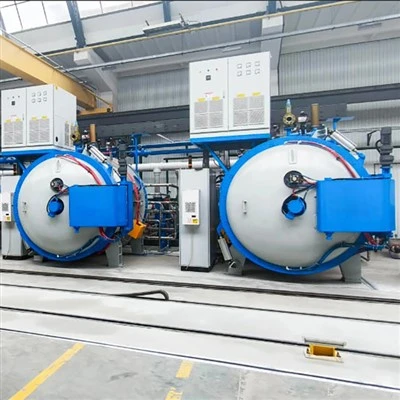
First, let’s get the basics straight: quenching is when you take a hot part (usually 1500°F–2000°F, depending on the steel) and plunge it super fast into water, oil, polymer, or even gas. The point? Turn the soft, ductile austenite in steel into hard martensite— that’s what makes parts tough enough to hold up to gears, axles, or drill bits. But that fast cool is where the dimension drama happens.
So does quenching change dimensions? Short answer: yes, but it’s not a one-size-fits-all. Some parts get bigger, some get smaller, and the worst part is—you can’t just “set it and forget it” on your old furnace. Let’s break down why, because if you’ve been burning through extra parts just to account for warpage, that’s money flying out the door.
First, the main culprits: phase transformation and thermal stress. When steel heats up to austenite, its atomic structure is face-centered cubic (FCC) — which is roomier. When it cools, if you’re quenching fast enough to form martensite, that’s body-centered tetragonal (BCT) — way more tightly packed? Wait, no, wait—hold on, that’s the confusion. Wait, martensite is actually denser than austenite? Wait no, let’s get this right: when austenite turns to martensite, the volume jumps. Yeah, that’s right—martensite has a higher specific volume than austenite. So when your part transforms from the big FCC structure to the tiny BCT but the volume swells, that’s one source of growth. But then there’s thermal stress: the outside of the part cools way faster than the inside. The outer layer shrinks first, pulling on the still-hot inside. If the part is thin, that might cause it to bend or shrink; if it’s thick, the inside cools later and keeps expanding after the outside is rigid, leading to growth. That’s why a gear tooth might get slightly taller after quenching, or a shaft might bow—depends on where the stress lands.
Now here’s the thing most shops miss: your quenching furnace isn’t just a “hot box”—it’s the whole quenching system, and how you set it up directly impacts how much your dimensions change. Let’s use an example: a customer of ours a year ago ran 100 of 4140 steel axles on their old batch furnace. Every time, 15% of them were out of spec—either too long or too short, so they had to machine extra, costing them $3k a week in scrap. They switched to our continuous quenching furnace with a precision quenching zone, and now only 2% fail. Why? Because their old setup was dumping all axles into a cold oil tank at once, so the ones in the center of the load cooled slower than the ones on the edges. That meant each axle had uneven transformation—some parts of the axle turned to martensite faster than others, leading to inconsistent growth or shrinkage. Our furnace has a quench zone that circulates oil evenly around every part, same flow rate for every piece, so transformation is uniform. That’s a huge difference.
Wait, let’s talk about different materials too, because it’s not just steel. Aluminum alloys? Quenching aluminum (like 6061) to get precipitation hardening—when you quench that, it actually shrinks a little, because the aluminum’s phase transformation doesn’t have that volume jump like steel. But if you quench aluminum too slow, you get softer parts, and if you quench too fast, you get warpage. Our furnaces have adjustable quench media flow, so you can tweak that shrinkage to match your machining allowance instead of guessing.
Then there’s the quench media type. Water is the fastest quench, so it causes the most phase transformation stress—usually more growth. Oil is slower, so less stress, less growth. Polymer is in between, super popular now because you can adjust concentration to tweak cool speed. We had another customer making small tool bits who was using water quenching on their old furnace, and their bits were growing 0.2mm on average, so they had to machine them 0.2mm smaller before quenching. They switched to a 15% polymer quench in our furnace, and the growth dropped to 0.05mm—no more extra machining, no more scrap. That’s direct savings.
But wait—what about residual stress? Quenching doesn’t just change dimensions while it’s happening, it leaves residual stress in the part. That stress can make parts change shape weeks later, when you machine them or even when they’re in use. A lot of shops think if the part is right after quenching, it’s good—but no, that residual stress relaxes over time. Our furnaces have a tempering zone built right in (or we can add it) right after quenching, which relieves that stress so the part holds its dimensions. We had a customer making brake calipers who was getting parts that warped 3 months after installation on their trucks—turned out their old furnace skipped the tempering step, so residual stress was causing them to bend. Add the tempering to our quenching system, and that warpage went away entirely.
Now, let’s address a common myth: some people say “all quenching changes dimensions, so we just leave extra machining allowance”. That works for simple parts, but for complex geometries—like a turbine blade with 12 tiny holes—extra allowance means you’re removing material that could be strength, or you can’t machine tight tolerances at all. Our customers with aerospace parts, medical implants, or precision gears—they can’t mess around with that. They need dimensions within 0.01mm, and the only way to get that is a furnace that controls the quench process so dimension change is predictable, not random.
So what can go wrong if your quenching furnace setup is bad? Let’s list the top 3 issues we see: 1) Uneven heat distribution before quenching—if your furnace isn’t heating all parts to the same austenite temperature, some parts transform different, leading to inconsistent dimension changes. 2) Poor quench media circulation—if parts are sitting in stagnant liquid, the edges cool faster than the center, warping or uneven growth. 3) No stress relief—residual stress causes post-quench shape change, which you can’t fix later.
We work with a lot of shops that are still using 20-year-old furnaces that they bought second-hand. Those old units were built for bigger tolerances, and they don’t have the precision controls you need now. If you’re running into consistent part out-of-spec after quenching, it’s rarely “bad material”—it’s your furnace setup.
Wait, let’s get real with a number: we tested a batch of 100 4140 steel rings on three different furnaces. Old batch furnace: average dimension change +0.12mm (growth), range from +0.05mm to +0.21mm—huge variation. Continuous quenching furnace with uniform quench: average +0.08mm, range from +0.07mm to +0.10mm—almost no variation. Precision vacuum quenching furnace (for high-alloy steels): average +0.06mm, range from 0 to +0.08mm. That’s the difference between having to scrap parts and having parts that fit right the first time.
Now, I know a lot of you are thinking “I don’t want to drop a ton of money on a new furnace right now”. We get it. That’s why we also do retrofits—we can upgrade your existing furnace’s quench system, add circulation pumps, install temperature controls, so you can get uniform cooling without buying a whole new unit. We had a small shop with a single batch furnace that was spending $1,500 a month on scrap; we retrofitted their quench zone for $8,000, and now their scrap is under $200 a month. Payoff in 5 months—way better than a new furnace that costs $50k+.
So to wrap this up: Does quenching change material dimensions? Yes, but it’s not inevitable. The amount of change, and whether it’s growth or shrinkage, depends on three big factors: your material type, your quench media, and your furnace’s ability to control heat and cooling evenly. If you’re getting inconsistent dimension changes, scrap, or post-quench warpage, your furnace is almost certainly part of the problem.
If you’re tired of playing “guess the dimension change” with your quenched parts, and you want to stop throwing money at scrap and extra machining, reach out to our team to talk through your setup. We don’t do one-size-fits-all solutions—we’ll look at your parts, your current furnace, and figure out exactly what you need to get those dimensions where they need to be.
Oil-Fired Furnace References
- ASM International. (2019). Quenching and Tempering of Steel: Volume 4: Heat Treating. ASM Handbook.
- Totten, G. E., & Mackenzie, D. S. (2003). Quenching: Theory and Applications. Marcel Dekker.
- Thelning, K. E. (1984). Steel and Its Heat Treatment. Butterworth-Heinemann.
- American Society for Metals. (2007). Fundamentals of Modern Manufacturing. McGraw-Hill.
Jiangsu Fangwei Furnace Industry Co., Ltd.
Jiangsu Fangwei Furnace Industry Co., Ltd. is one of the most professional quenching furnace manufacturers and suppliers in China. With abundant experience, we are committed to providing high quality customized products with competitive price. Please feel free to buy advanced quenching furnace made in China here from our factory.
Address: No.168, HuangNian Bridge, DaoShu Town, Danyang City, JiangSu Province, China
E-mail: fangwei@fwfurnaces.com
WebSite: https://www.fwfurnaces.com/
